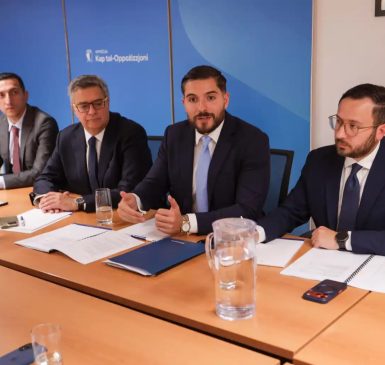
Malta Chamber of SMEs meets Opposition Leader ahead of Budget 2027
08 October 2026
Ahead of the Budget 2027, council members of the Malta Chamber of SMEs met earlier...
GRTU regrets that there were no improvements made to the Consumer Rights Directive to boost cross-border e-commerce at the plenary vote of the European Parliament. After more than two years of discussion the European Parliament has not provided businesses an environment to increase their online cross-border activities but instead created more obstacles for them not only for cross-border trade but even for businesses operating on domestic markets.
The 5th Commission Consumer Conditions Scoreboard has shown that businesses providing online products cross-border has decreased from 25% in 2009 to 22% in 2010. Businesses need help in order to be competitive in a globalised market, but what the Parliament has adopted does not provide any solutions to the current problems. On the contrary it creates even more obstacles for businesses involved in distance and off-line transactions, in particular for SMEs.
The mixed minimum and full harmonised approach will not provide more confidence in the internal market: it will increase legal fragmentation, creating more market barriers and extra compliance costs, and so undermining business activities across Europe and especially e-business.
Although there is a common set of rules on information requirements the too extensive list will make it impossible for businesses to carry out their day to day activities. The exemption for off-premises contracts for products under 40 Euros is only applicable if there is an immediate transaction. This means that for small amount products which will be delivered and paid at a later stage, an enormous administrative burden and costs is created.
Receiving a confirmation by the trader on a durable medium when a consumer orders a product by phone is not always feasible. If you order flowers to be delivered in a few hours, you cannot confirm this in written first. Reimbursing consumers without having received the goods opens up the door for fraud which will be detrimental for businesses in particular for small businesses. Moreover obliging traders to deliver their goods to consumers within the EU if he/she accepts to bear all the costs is unacceptable since the law of the consumer's habitual residence will be applicable in this case. At the end of the day, there is a high risk that there will be even less consumer choice and increase of product prices.
08 October 2026
Ahead of the Budget 2027, council members of the Malta Chamber of SMEs met earlier...

08 October 2026
The Malta Chamber of SMEs is concerned by comments made by Minister Clyde Caruana, attributing...

17 September 2026
It is with great sadness that we remember Joe Attard, CEO of Green MT Limited...
The Malta Chamber of SMEs represents over 7,000 members from over 90 different sectors which in their majority are either small or medium sized companies, and such issues like the one we're experiencing right now, it's important to be united. Malta Chamber of SMEs offers a number of different services tailored to its members' individual requirements' and necessities. These range from general services offered to all members to more individual & bespoke services catered for specific requirements.
A membership with Malta Chamber of SMEs will guarantee that you are constantly updated and informed with different opportunities which will directly benefit your business and help you grow. It also entails you to a number of services which in their majority are free of charge and offered exclusively to its members (in their majority all free of charge).