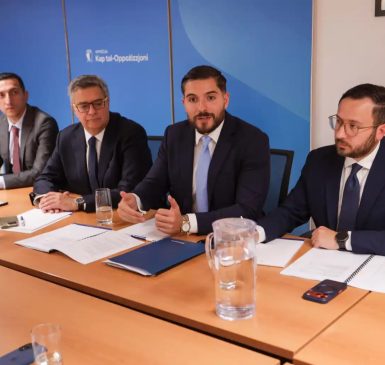
Malta Chamber of SMEs meets Opposition Leader ahead of Budget 2027
08 October 2026
Ahead of the Budget 2027, council members of the Malta Chamber of SMEs met earlier...
Although the Priceclub debacle of 2001 should have been a hard-learned lesson for many and eye-opener for the future, credulous businessmen still appear to be easy prey for fast and sweet talking ‘entrepreneurs’ who manage to persuade them to let go of their hard-earned cash denting heavily the cash flow of their companies/business activities, which in some cases, may even result in bankruptcy. In the last few weeks, newspapers have reported a quasi-Priceclub scenario – if businessmen who were bitten then have again fallen prey, they have not learnt their lessons well.
At that time, businesses had no external means or the required tools to attempt to foresee and avoid such situations with the ‘gut feeling’ and the ‘friend of friends’ methods prevailing (and, unfortunately, still do today). External means and tools are today available, therefore, excuses, serve only too thinly veil attempts to hide the fact that they have again fell for it.
In certain sectors the profit margins are so thin, that a single important default would wipe away years of hard-work. The phrase ‘it will not happen to me’ has to be deleted from any existing vocabulary, dictionary, thesaurus, etc.. Because, if one does not take reasonable precautions and continuously gauge the risks involved, they will get caught out .
A company should use all possible methods that are available in the market, as one single tool may not be enough to filter out the rotting apples. A small investment may save your company thousands of euros or even ensure its survival.
Businesses in Malta are still shying away from data sharing, which in itself is a form of insurance against bad debts. Volunteering aged debtors to a third party whose expertise is the manipulation of such data would filter out a lot of the potential culprits who are experts at hiding their financial difficulties. They may even succeed to delude banks notwithstanding their own strict internal safe-guards.
Local banks must also stop hiding behind the Banking Act 1994 and commence to share data, at least amongst themselves, even if this is just one side of the coin. The sharing of data would reduce drastically the options of would-be fraudsters by blocking the possibility of bank hopping. Banks have obligations towards their customers especially towards the normal saver whose money is being loaned out to these companies.
As mentioned previously sharing of data between banks is only one side of the coin. The other side is the actual day-to-day commercial aspect of the data which is comprised of both positive and negative facts, which the banks must have access to if they want to have the full picture of a data subject at any given point.
Recently, we have seen a number of intentional or unintentional situations, which, with proper controls in place, may have been foreseen and avoided. Malta is lagging behind on its credit control sector and it must scrutinize the playing field as well as the players, amend the local legal framework and even, if need be, introduce new legislation to bring Malta up to the same level as its EU counter-parts. The business community has to protect the economy from fraud and bad practice, and exposing individual of potential “scams”
Let us not let defaulters, fraudsters and similar hide behind the relevant legislation, put in place to protect the honest citizen.
08 October 2026
Ahead of the Budget 2027, council members of the Malta Chamber of SMEs met earlier...
08 October 2026
The Malta Chamber of SMEs is concerned by comments made by Minister Clyde Caruana, attributing...

17 September 2026
It is with great sadness that we remember Joe Attard, CEO of Green MT Limited...
The Malta Chamber of SMEs represents over 7,000 members from over 90 different sectors which in their majority are either small or medium sized companies, and such issues like the one we're experiencing right now, it's important to be united. Malta Chamber of SMEs offers a number of different services tailored to its members' individual requirements' and necessities. These range from general services offered to all members to more individual & bespoke services catered for specific requirements.
A membership with Malta Chamber of SMEs will guarantee that you are constantly updated and informed with different opportunities which will directly benefit your business and help you grow. It also entails you to a number of services which in their majority are free of charge and offered exclusively to its members (in their majority all free of charge).