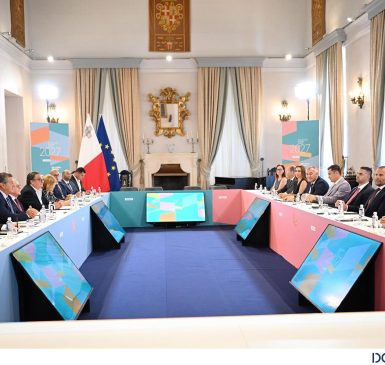
SME Chamber presents 40 Budget 2027 proposals, calls for productivity-driven budget and cross-party taskforce on Malta’s National priorities
16 September 2026
The Malta Chamber of SMEs has presented 40 proposals for Budget 2027 during a meeting...

GRTU Director
General and EESC Employers Representative Vincent Farrugia has this week
participated at the EESC Transport, Energy, Infrastructure and the Information
society section meeting during which addressed the problems faced by Energy
Islands in Europe, particularly due to their insularity issues, making
reference to a very important EESC opinion on the issue.
Energy insularity
places the affected countries and regions in Europe at an economic, as well as
social and environmental disadvantage since they are often heavily dependent on
fossil fuels. It leads to significant price discrepancies, which contribute to
creating disparities in terms of solidarity and uniform development across
European regions.
Energy insularity
covers a range of varying circumstances, but which have virtually identical
consequences irrespective of the situation. Insularity can result in:
increased supply insecurity;
price variations, often with an upward trend, and
dependent industrial and trade activities;
more significant energy poverty for people in these
States or regions;
a negative impact on their economic competitiveness;
increased environmental pressure;
Instability in political and economic relations
between the EU and third countries.
Furthermore Demand
for energy is high and rising in energy islands. Given this situation, the
consequence of a potentially less reliable and significantly more expensive
supply is undermining the economic competitiveness of energy islands.
Similarly, high energy bills put significant pressure on household budgets.
The consequences
of energy insularity should be better assessed in terms of the growth,
competitiveness, and sustainable development of the affected regions as well as
in terms of solidarity, cohesion and "lost revenues" for the rest of
the EU due to the absence of a complete and functional energy market throughout
the EU.
Mr Farrugia
appealed to the Commission to give priority to the EESC Plenary Conclusions
that energy islands represent a cost for all. This cost must be evaluated and
the solutions for reducing it must be incorporated in a comprehensive approach.
The European energy policy has to be completed and granted appropriate means of
action, commensurate with both the Member States' level of interdependence and
the difficulties they encounter. Within
this context Malta should be placed high up in the priority listing of energy
islands hit hardest by the energy insularity.
16 September 2026
The Malta Chamber of SMEs has presented 40 proposals for Budget 2027 during a meeting...

11 September 2026
The Malta Chamber of SMEs is raising serious concerns over the impact of the new...
22 July 2026
The Malta Chamber of SMEs acknowledges the significant investment and continuous efforts undertaken over recent...
The Malta Chamber of SMEs represents over 7,000 members from over 90 different sectors which in their majority are either small or medium sized companies, and such issues like the one we're experiencing right now, it's important to be united. Malta Chamber of SMEs offers a number of different services tailored to its members' individual requirements' and necessities. These range from general services offered to all members to more individual & bespoke services catered for specific requirements.
A membership with Malta Chamber of SMEs will guarantee that you are constantly updated and informed with different opportunities which will directly benefit your business and help you grow. It also entails you to a number of services which in their majority are free of charge and offered exclusively to its members (in their majority all free of charge).