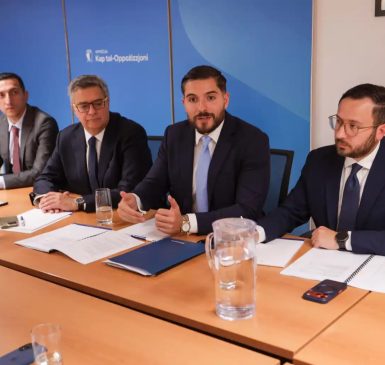
Malta Chamber of SMEs meets Opposition Leader ahead of Budget 2027
08 October 2026
Ahead of the Budget 2027, council members of the Malta Chamber of SMEs met earlier...
 On 19 October 2011, the European Commission DG Trade published the 8th Report on potentially trade restrictive measures adopted by third countries in the aftermath of the economic crisis. The Report's findings call again for close attention to the recent wave of trade restrictions adopted in particular by emerging economies over the past twelve months.
The analysis online:
(http://ec.europa.eu/trade/maintenance/html/press-release-743-458_en.htm),
It paints a worrisome picture, indicating the constantly growing number of new potentially trade restrictive measures increasingly becoming part of targeted industrialization policies by third countries. In addition to their individual distortive potential, many measures have a mutually reinforcing character, being part and parcel of the same industrialisation package.
The increasing trade restrictive measures pose a systemic market access problem, as many measures introduced during the economic crisis have remained in force, and are frequently prolonged. Moreover, the number of measures that lapsed in the past twelve months remains unsatisfying if compared to the emergence of new restrictions.
All in all, the Commission notes 424 measures remaining in force or planned by third countries and G20 economies in particular. In the past twelve months, 131 new measures have been noted. Only 17% of all measures have been removed so far (76), with 40 measures eliminated or lapsing in the past year.
The Commission remains particularly concerned about measures adopted in the area of government procurement as well as by export duties and other export restrictions.
The WTO report on trade-related developments in G20 countries, issued on 26 October 2011, confirms these worrisome trends, admitting that some countries, instead of fulfilling the Washington commitment, pursue a policy in the opposite direction. The WTO figures on removal of measures in place (19%) coincide with those of the EU (17%).
These findings clearly indicate insufficient respect by G20 countries for their standstill and roll-back commitments consistently made since the onset of the economic crisis. The upcoming G20 summit in Cannes on 3-4 November provides another opportunity to highlight the importance of resisting protectionist tendencies among the major economies.
08 October 2026
Ahead of the Budget 2027, council members of the Malta Chamber of SMEs met earlier...
08 October 2026
The Malta Chamber of SMEs is concerned by comments made by Minister Clyde Caruana, attributing...

17 September 2026
It is with great sadness that we remember Joe Attard, CEO of Green MT Limited...
The Malta Chamber of SMEs represents over 7,000 members from over 90 different sectors which in their majority are either small or medium sized companies, and such issues like the one we're experiencing right now, it's important to be united. Malta Chamber of SMEs offers a number of different services tailored to its members' individual requirements' and necessities. These range from general services offered to all members to more individual & bespoke services catered for specific requirements.
A membership with Malta Chamber of SMEs will guarantee that you are constantly updated and informed with different opportunities which will directly benefit your business and help you grow. It also entails you to a number of services which in their majority are free of charge and offered exclusively to its members (in their majority all free of charge).