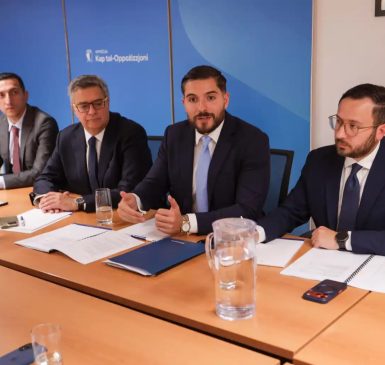
Malta Chamber of SMEs meets Opposition Leader ahead of Budget 2027
08 October 2026
Ahead of the Budget 2027, council members of the Malta Chamber of SMEs met earlier...

The European Commission initiated an
interim review investigation of the anti-dumping measures applicable to imports
of bicycles originating in the People's Republic of China. The request contains sufficient
initial evidence that the anti-dumping
measures on imports of bicycles originating in the People's Republic of China
are being circumvented by means of transhipment via Indonesia, Malaysia, Sri
Lanka and Tunisia and by means of assembly operations of certain bicycle parts
from the People's Republic of China.
This temporary review on anti-dumping
underlines the following:
The
R546 General Disclosure Document reveals all the details on the anti-dumping
interim review as well as the investigation on China allegedly subsidizing
Chinese bike exporters.
The R563 document reports on DG Trade's circumvention investigation into bike
companies based in various Asian countries evading the 48.5% dumping duty
through transhipments of bikes made in China in their export to the European
Union.
DG Trade's R546 General Disclosure
Document says on China subsidizing Chinese bike exporters that: "The
Chinese aluminium market is distorted due to significant intervention of the
State." DG Trade comes to the same conclusion for the country's steel
market. On this and numerous other investigation findings DG trade concludes
that Market Economy Treatment (MET) should be rejected for the Chinese groups
that requested such treatment.
On the existing 48.5% anti-dumping
levied on bikes imported from China, the R546 General Disclosure Document says:
"The continuation of measures on imports of bicycles originating in the
PRC would clearly be in the interest of the Union industry and the Union
suppliers of bicycle parts. It will allow the Union industry to grow and
improve its situation caused by the dumped imports.
Furthermore, the importers would not
be substantially affected since fairly priced bicycles would still be available
on the market from the PRC and other third counties. Also, due to the extensive
use of the existing exemption scheme by the Union industry, it was concluded
that the existing measures had no significant negative impact on the
users/consumers. In contrast, if measures were repealed, Union bicycles
producers will likely close production, thus also threatening the existence of
Union bicycle parts producers."
08 October 2026
Ahead of the Budget 2027, council members of the Malta Chamber of SMEs met earlier...

08 October 2026
The Malta Chamber of SMEs is concerned by comments made by Minister Clyde Caruana, attributing...

17 September 2026
It is with great sadness that we remember Joe Attard, CEO of Green MT Limited...
The Malta Chamber of SMEs represents over 7,000 members from over 90 different sectors which in their majority are either small or medium sized companies, and such issues like the one we're experiencing right now, it's important to be united. Malta Chamber of SMEs offers a number of different services tailored to its members' individual requirements' and necessities. These range from general services offered to all members to more individual & bespoke services catered for specific requirements.
A membership with Malta Chamber of SMEs will guarantee that you are constantly updated and informed with different opportunities which will directly benefit your business and help you grow. It also entails you to a number of services which in their majority are free of charge and offered exclusively to its members (in their majority all free of charge).